

(A Picture is Worth a Thousand Words!)
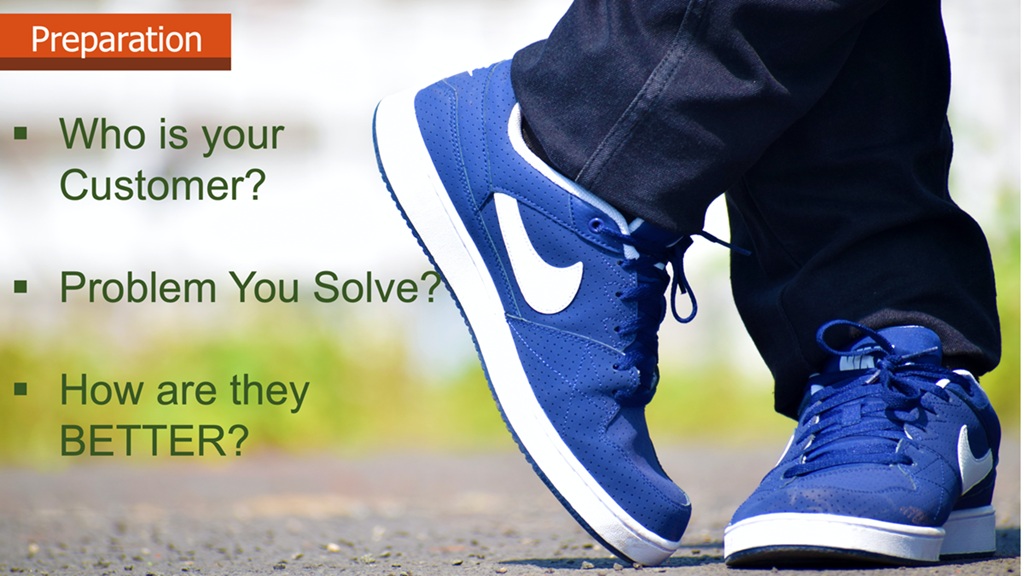
When the slide above is on my screen, I am talking to the audience about how to prepare for a presentation.
First, I tell the audience this slide isn’t to promote Nike runners.
The purpose of having the shoes on the screen is to remind the person preparing to engage an audience that their top priority is to imagine themselves walking in their audience’s shoes.
This article isn’t just about presentations. Every time you ask someone to listen to an idea, support a proposal or change the way they do something, you are communicating with an audience
Your images MUST add value!
When you use visuals to deliver a particular message, what happens is that after the event, people remember the image.
Which then helps them remember your key messages.
Walk in your audience’s shoes!
Communication should never be about what you want, but about what you understand the audience wants.
The three key words I have on the screen are
- Audience
- Problem
- Better
The Audience:
When I talk about the audience, I remind the speaker to research their audience, whether that’s one person or a group of people, perhaps in an organisation.
Look for connections to people in the room in advance of the meeting. Do you have mutual friends, business associates, sporting interests or educational background?
What you should be hoping to do is find out what this person/group need(s) from this conversation.
The Problem:
People want their problem solved, which is why they attend and why you’ve been asked to speak.
When you’re talking to the audience about the problem you believe you can solve for them, avoid technical language and jargon at all costs.
The skill all good communicators share is the ability to tell stories that explain the problem and provide examples to help the audience to understand.
Examples through stories also let you show your expertise while sharing your knowledge in a conversational and engaging way.
The END:
I’m sure you have all experienced this, whether it’s the eulogy of a much-loved family member or the best man’s speech at a wedding; the difficulty is that people don’t know how to stop.
So, the audience is sitting there thinking this was good, but way too long.
We all have relatives and work colleagues who just do not know how to stop.
BETTER:
Close the conversation by telling the audience how they will be BETTER!
Good speakers paint word pictures that help the audience see the value of what is on offer and understand how people will be better after implementing your ideas and suggestions.
e.g.
- A customer who understands the value
- Senior manager agreeing with an idea
- A difficult conversation ending with agreement rather than resistance
When your audience buys into what you propose, you and they will be BETTER
How to fill the gap between the problem story and how the audience is BETTER is a conversation for another day.
But if you want to avoid sending your audience to sleep, here are a few things I’d leave out …
- A long history of our company
- Don’t say this: “You probably can’t read this” … just reduce the content and use a bigger font, 28 as a minimum.
- Key Performance Indicators (KPIs) … Boring
- Graphs 1 to 9 – Never
PS
Do you need to be BETTER at getting people to listen, understand and take action?
Send me an email, and I’ll do my best to help you.